|
Congress heard 64
such appeals between 1776 and 1780.
They added to the already vexing Congressional
workload.
Litigants were not shy about appealing. Prize cases could be
complicated and
controversial. More
than one ship might
participate in a capture and dispute the credit.
(Under admiralty law, even a ship which watched
a capture could share in the
credit, since her mere presence may have helped induce the prize to
surrender.) Or a
ship owned by a Briton might carry cargo
on behalf of a Spaniard—the former was liable to seizure, but the
latter had to
be returned to its owner.
As a
consequence, Congress
granted itself, in the Articles of Confederation (drafted in November
1777),
power of “appointing courts for the trial of piracies and felonies
committed on
the high seas, and establishing courts for receiving and determining,
finally,
appeals in all cases of captures”.
The Articles
remained unratified until 1781, but Congress
exercised the power to create a court anyhow, in January 1780. The panel was named the
Court of Appeal in
Cases of Capture, and consisted of three independent, salaried
judges. Congress
elected William Paca of
Maryland, Titus Hosmer of Connecticut, and Cyrus Griffin of Virginia as
judges. They were
the first independent federal
judges in American history, sitting as the first federal court.
The Court began
working through the backlog of appeals, and
heard new cases as they arose. What
of
Captain Miller and his prize, the Resolution? The Court had bad news for
Mr. Miller. Not
only did the judges agree with
Pennsylvania that the Resolution
had
to be returned to her original owner, but they found that the seizure
of the
cargo had been illegal as well. Miller
came away empty handed, worse off than if he had accepted the original state verdict.
But wait! New
evidence surfaced, and the Court allowed a re-hearing six months later. Part of the cargo, it
turned out, had been
shipped on behalf of three British trading firms, and as such was a
valid
prize. Mr. Miller,
his crew, and the
owners of the Ariel achieved at
least
partial satisfaction, although still less than they had gotten from Pennsylvania.
Titus Hosmer died
in 1780, and William Paca resigned in
1782. They were
replaced by George Read
of Delaware and John Lowell of Massachusetts. The
Court of Appeal in Cases of Capture
eventually heard and decided 56 prize cases. Congress dissolved it in
1785,
after the coming of peace.
In 1789, Congress
under the Constitution of the United States (COTUS) created a much
larger
federal judiciary, with expanded jurisdiction.
George Washington at least had not forgotten
about the prize courts, because he included Paca, Griffin, and Lowell
among his
first nominations to the new federal bench.
Their fellow former jurist, George Read, had been
elected
to the Senate
by Delaware and was among the Senators voting to confirm them.
Sources: J.
C. Bancroft Davis, Federal
Courts Prior to the Adoption of the Constitution, appendix
to United States Reports Volume 131, 1888; Donald A. Petrie, The Prize
Game: Lawful Looting on the High
Seas in the Days of Fighting Sail, 1999;
American War of Independence at
Sea web site, www.awiatsea.com, accessed
2016; Miller v.
The Ship Resolution,
2 U.S. 1 (1781)
|
The
Articles of Confederation and the Navy
Captain Miller and
his fellow privateers represented one arm of United States naval power
during the Confederation era; the Continental Navy represented the
other. The Continental Congress created the Navy in October 1775,
shortly after the outbreak of the Revolutionary War. The Articles of
Confederation gave Congress the power to raise sea forces, build and
purchase “vessels of war”, appoint “all the officers of the naval
forces”, make rules for their government, and direct their operations.
After the coming of peace in 1783, Congress exercised its power over
the Navy in the most drastic manner possible—it disbanded and sold it.
The
Continental Congress launched its Navy by buying,
upgrading, and arming merchant ships, and then, backed by paper
currency rolling off of its printing presses, ordered the construction
of
thirteen frigates from scratch beginning in 1776.
(Frigates were relatively small warships built for
speed and maneuverability.) This
modest force couldn’t slug it out ship for ship with the Royal Navy,
which was the
largest and best in the world.
But the Continental Navy could and did harass
British
merchant ships and pick off isolated British warships.
Between 1777 and 1779, Captains Gustavus
Conyngham and John Paul Jones even took the war to the British Isles,
capturing prizes in British waters and raiding the British coast.
At the same time, American privateers were
doing their worst. Every
capture cost British merchants money and resulted in higher maritime
insurance
rates, undermining British support for the war.
On
February 7, 1781, Congress created the office of
Secretary of Marine to centralize management of naval operations. But alas, by 1781, the
printing presses were
no longer rolling, and the navy was becoming an extravagance the nation
couldn’t
afford. Ships were
lost due to accident,
damage, and capture, and Congress had no money to replace them. In addition, the navy had
trouble manning such ships as it had.
Privateers
out-competed the Navy in recruiting captains and crews; privateers paid
better (when they were successful at capturing prizes) and were less
dangerous,
because they ran away from enemy warships rather than seeking them out.
By fall
1781, the Continental Navy was down to two remaining
frigates, with two more plus one ship of the line (a 74-gun behemoth)
under construction. In
July Congress downgraded the title of the head of the navy (not yet
appointed) to
Agent of Marine, and in September Congress folded the office into the
Department
of Finance, with Superintendent Robert Morris also assuming
responsibility
for the navy.
In
September 1782 the ship of the line (the America)
was ready for launch, but
Congress voted unanimously to give it to France, knowing it would be
too expensive to crew and maintain.
News
of peace with the British arrived in March 1783, making the navy even
less
of a priority. Congress
directed Morris to
sell the remaining ships, one by one, to raise a few thousand dollars
each and save maintenance costs.
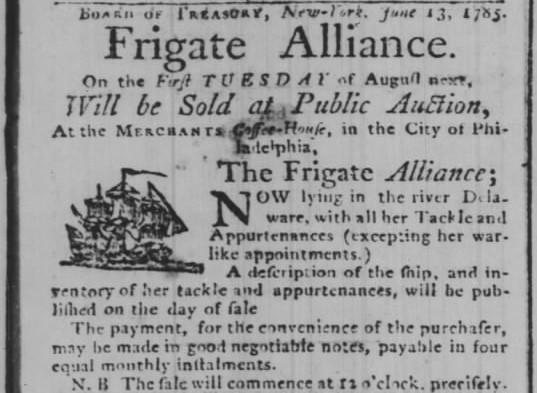
By 1785
the navy was down to one remaining ship, the frigate
Alliance.
Congress voted eight states to zero (but with
four individual members dissenting) on June 3, 1785 to order it sold. The sale took place in
Philadelphia on August
1, and with the final bang of the auctioneer’s gavel, awarding the Alliance to one Richard Coburn for
$7,700 in government bonds (worth about $1,500 in specie), the
Continental Navy ceased to exist.
Sources: Journals
of
the Continental Congress, Volumes 19, 21, 23, and 28; Tim
McGrath, Give Me a Fast Ship: The Continental
Navy
and America’s Revolution at Sea, 2014; Robert H. Patton, Patriot Pirates; The Privateer War for
Freedom and Fortune in the American Revolution, 2008
|
 In March 1781, two Philadelphia merchants
purchased the
brigantine Ariel, fitted her
out
with cannons, and hired a captain and crew. They
obtained
a letter of marque and reprisal from the state of Pennsylvania, and
sent the Ariel to cruise the
Atlantic in search
of British plunder. Within
a month, the Ariel spotted a cargo
ship, the Resolution, being
escorted by a British
privateer, the Revenge.
In March 1781, two Philadelphia merchants
purchased the
brigantine Ariel, fitted her
out
with cannons, and hired a captain and crew. They
obtained
a letter of marque and reprisal from the state of Pennsylvania, and
sent the Ariel to cruise the
Atlantic in search
of British plunder. Within
a month, the Ariel spotted a cargo
ship, the Resolution, being
escorted by a British
privateer, the Revenge.