Where
was the National Capital?
The Articles of
Confederation and the Wandering
Congress
On June 21, 1783,
five hundred angry soldiers surrounded Congress as it sat in session in
the
State House (now Independence Hall) in Philadelphia.
They shouted curses, brandished bayonets, and
demanded back pay. Making
matters worse,
some of the local tavern keepers either supported the soldiers, or were
intimidated into doing so. In
the quaint
words of James Madison, “spirituous drink from the tippling houses
began to be
liberally served out to the soldiers, & might lead to hasty
excesses”.
No
member of
Congress needed to be told what these “excesses” might be. The century before,
England itself had
rebelled against the Crown, and an army led by Oliver Cromwell had led
Parliament
to victory. After
the war, Cromwell’s
army—disgruntled over the same lack of pay—had purged Parliament and
set up a
military dictatorship. Was the United States about to undergo
a military coup?
The
First Continental Congress
assembled in Philadelphia in 1774, simply because Philadelphia was a
large city near the midpoint of the thirteen rebellious
colonies.
When Congress declared independence two years later,
Philadelphia became the national capital, although few used
the
word at the time. Philadelphia was just "the place where Congress met",
and Congress at that time was the entirety of the federal government.
During
the Revolutionary War, the British twice threatened and once
occupied Philadelphia, forcing Congress to flee to Baltimore and then
to York, Pennsylvania. Congress finished drafting the
Articles of
Confederation in York (see Drafting the Articles).
The Articles said nothing about a national capital and
reserved
to Congress the power to "adjourn to any place within the
United
States".
By
the time the Articles were ratified (March 1781), the war had moved
elsewhere and Congress had returned to Philadelphia, and would have
been
happy to stay there--especially after the coming of peace in 1783.
But, the soldiers in June of that year were frightening.
The government of Pennsylvania offered little in the way
of
protection. On June 24, 1783, Congress determined to flee to
the
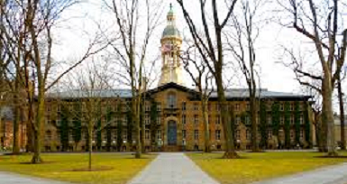
nearest public building outside of Pennsylvania which was available on
short notice, which
turned out to be Nassau Hall (above right) on the grounds of the
College of New Jersey (now called Princeton University).
Princeton
proved to
be pleasant—and safe—enough, but it could not be more than a temporary
home. The
accommodations were more suited
to college students than to members of Congress, and it would hardly
impress foreign
ambassadors who were reporting to the United States in increasing
numbers. Congress
would move to a larger city, but which one? Only a two-city
package could secure a majority of states in support, so Congress voted (October 1783)
to alternate between sitting in Annapolis, Maryland, and Trenton, New
Jersey.
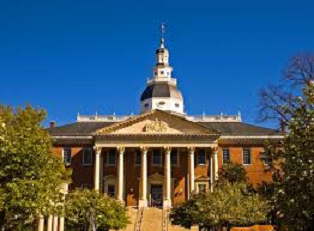
Congress accordingly spent its 1783-84 session in Annapolis, and began its 1784-85 session in Trenton. In
Annapolis,
Congress met in the Maryland State House. In
Trenton, Congress met in the French Arms Tavern (no longer standing). Trenton was not then the
capital of New
Jersey, and had no legislative building.
Congress,
however, was no longer the whole of the federal government.
In 1781, Congress had created Executive
Departments. As
Congress relocated, its executive
departments sometimes
relocated with it, sometimes not. The
Office of Finance, with a substantial staff, remained
in Philadelphia.
Some members of Congress applauded this
separation. Arthur Lee of Virginia, who hated Superintendent of
Finance Robert Morris, celebrated that Morris' influence "has
manifestly diminished since the removal (of Congress) from
Philadelphia, and the fixing of Congress in any other place will I hope
restrain it in due bounds". But separation did not
conduce to efficient government, nor to a
stable civil
service. In 1784,
Congress wished for
John Jay to become Secretary of Foreign Affairs.
Jay refused unless Congress settled on a
single capital. Congress
wanted Jay
badly enough that it acquiesced, and voted on December 23, 1784 to meet
in New
York beginning in January, 1785. Trenton
had served as the capital for less than two months.
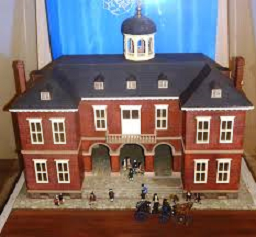 In
New York, Congress
met in the Old City Hall (left), later renamed Federal Hall, while the
executive
departments set up in Fraunces’ Tavern.
In
New York, Congress
met in the Old City Hall (left), later renamed Federal Hall, while the
executive
departments set up in Fraunces’ Tavern.
One
must not view
this travel as evidence that nobody wanted Congress.
On the contrary, everybody
wanted Congress.
New Jersey resolved that it was “highly honored by the
presence of
Congress”. Rhode
Island offered Newport
as the federal capital. Philadelphia
begged Congress to return. The
frequent
relocations resulted from the push and pull of Congressional politics.
In
hindsight, nevertheless,
the abandonment of Philadelphia in 1783 was a mistake.
George Washington was not Cromwell, and the
blustering soldiers sobered up and apologized within a day. Congress appeared weak and
fearful in
fleeing. The
subsequent relocations wasted
time, both in debate and in the relocations themselves.
Frequent movement lowered the prestige of Congress and
exacerbated the problem
of Congressional attendance,.
Congress
under the
Constitution of the United States (COTUS) finally returned to
Philadelphia in 1790, and voted to build a
new and
permanent capital on the banks of the Potomac between Virginia and
Maryland. The
resulting city of
Washington became the national capital in 1800.
Sources:
Edmund
Cody Burnett, The Continental Congress,
1941; Thomas Fleming, The Perils
of Peace: America’s Struggle for Survival After Yorktown, 2007; Papers of Robert Morris, Volume 8; Letters of
Delegates to Congress, Volumes
20 and 22
©
2019 Clionic Enterprises | Back
to Home Page | Back
to Interesting Things |