State
Boundary Disputes
The French statesman Talleyrand
once
expressed a preference, often misattributed to Napoleon, for a
constitution
that was “short and obscure”. The
Articles of Confederation, for the most part, met his preference. They were relatively brief (3,400 words) and often ambiguous.
On one subject, however, they were
mind-numbingly verbose and detailed: the resolution of state boundary
disputes. The
relevant
provision, part of Article IX, must be quoted in full to display its
prolixity:
The
United States, in Congress assembled, shall
also be the last resort on appeal in all disputes and differences now
subsisting or that hereafter
may arise between two or more states concerning
boundary, jurisdiction or any other cause whatever; which authority
shall
always be exercised in the manner following. Whenever the legislative
or
executive authority or lawful agent of any state in controversy with
another
shall present a petition to Congress stating the matter in question and
praying
for a hearing, notice thereof shall be given by order of Congress to
the
legislative or executive authority of the other state in controversy,
and a day
assigned for the appearance of the parties by their lawful agents, who
shall
then be directed to appoint by joint consent, commissioners or judges
to
constitute a court for hearing and determining the matter in question:
but if
they cannot agree, Congress shall name three persons out of each of the
united
states, and from the list of such persons each party shall alternately
strike
out one, the petitioners beginning, until the number shall be reduced
to
thirteen; and from that number not less than seven, nor more than nine
names as
Congress shall direct, shall in the presence of Congress be drawn out
by lot,
and the persons whose names shall be so drawn or any five of them,
shall be
commissioners or judges, to hear and finally determine the controversy,
so
always as a major part of the judges who shall hear the cause shall
agree in
the determination: and if either party shall neglect to attend at the
day
appointed, without showing reasons, which Congress shall judge
sufficient, or
being present shall refuse to strike, the Congress shall proceed to
nominate
three persons out of each state, and the secretary of Congress shall
strike in
behalf of such party absent or refusing; and the judgment and sentence
of the
court to be appointed, in the manner before prescribed, shall be final
and
conclusive; and if any of the parties shall refuse to submit to the
authority
of such court, or to appear or defend their claim or cause, the court
shall
nevertheless proceed to pronounce sentence, or judgment, which shall in
like
manner be final and decisive, the judgment or sentence and other
proceedings
being in either case transmitted to Congress, and lodged among the acts
of Congress
for the security of the parties concerned: provided that every
commissioner,
before he sits in judgment, shall take an oath to be administered by
one of the
judges of the supreme or superior court of the state, where the cause
shall be
tried, "well and truly to hear and determine the matter in question,
according to the best of his judgment, without favor, affection or hope
of reward:" provided also, that no state shall be deprived of territory
for the
benefit of the United States.
All
controversies concerning the private right
of soil claimed under different grants of two or more states, whose
jurisdictions as they may respect such lands, and the states which
passed such
grants are adjusted, the said grants or either of them being at the
same time
claimed to have originated antecedent to such settlement of
jurisdiction, shall
on the petition of either party to the congress of the united states,
be finally determined as near as may be in the same manner as is before
prescribed for deciding disputes respecting territorial jurisdiction
between
different states.
The first
amazing
thing about this procedure is that it was used.
The second amazing thing is that, after a fashion, it
worked.
State boundary
disputes, to be sure, demanded attention.
They threatened to tear apart the United States. State boundaries were
based on British colonial charters, which were often vague,
contradictory, and written in ignorance of American geography.
When states claimed the
same land, they would
sell the same land; and when they sold the same land, settlers bearing
conflicting title deeds were left to fight it out on the spot. Settlers from Pennsylvania
and Connecticut
had fought two nasty “Pennamite Wars” before the Revolution; several
individuals had lost their lives, and the dispute was put in abeyance
only out
of need to make common cause against the British.
Other disputes
festered even in the midst of the Revolutionary War. Ethan
Allen and his Green
Mountain Boys took
up arms in 1775 to defend their New Hampshire Grants against
interlopers from
New York. When New
Hampshire lost interest in the
matter, settlers proclaimed the independent Republic of Vermont (1777;
see The Race to
Become the
Fourteenth State).
Small
wonder, then,
that when the Articles offered a means of dispute resolution, it was
used; and
that the
state of Pennsylvania was the first supplicant.
Pennsylvania vs.
Connecticut
 It
seems odd,
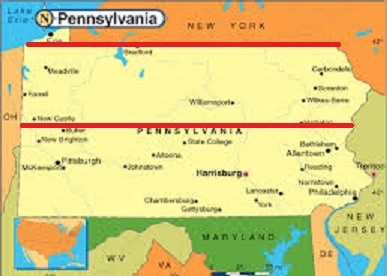
today, that Pennsylvania and Connecticut would have a border dispute. They no longer have a
border. Connecticut
thought that they had a border in
1781, however, because Connecticut claimed a strip of land from sea to
sea (or at least to the Mississippi River),
which included what today makes up the northern half of Pennsylvania. Connecticut offered to
cede the western part
of its strip to the United States in 1780, but retained its claim up to
the
western boundary of Pennsylvania.
It
seems odd,
today, that Pennsylvania and Connecticut would have a border dispute. They no longer have a
border. Connecticut
thought that they had a border in
1781, however, because Connecticut claimed a strip of land from sea to
sea (or at least to the Mississippi River),
which included what today makes up the northern half of Pennsylvania. Connecticut offered to
cede the western part
of its strip to the United States in 1780, but retained its claim up to
the
western boundary of Pennsylvania.
Thus
it was that
eight months after the Articles of Confederation were ratified, on
November 3,
1781, the Executive Council of Pennsylvania laid a petition before
Congress
acknowledging the existence of a dispute, and asking for resolution via
the
procedure laid out in Article IX.
Eleven
days later, Congress duly forwarded notice to the government of
Connecticut,
and set June 24, 1782 as the date for agents for the two sides to
appear before Congress in
Philadelphia.
Pennsylvania
appointed five agents, who appeared on the appointed date. Two of them, Joseph Reed
and James Wilson,
were former members of Congress.
Connecticut appointed three agents, two of whom, Jesse
Root and
Eliphalet Dyer, were sitting members of Congress.
Only Dyer was present on the appointed day,
so he asked for a continuance. It
was
granted. Connecticut
may have realized
that it had the weaker case, because its agents repeatedly sought
delay.
On
July 16, both sides
were ready to proceed. Congress
directed
them to attempt to agree on judges.
Perhaps
surprisingly, the two states succeeded.
They agreed on a panel of seven judges from neutral states. Congress directed the
judges to convene at
neutral ground in Trenton, New Jersey on November 12, 1782.
Arguments
before
the judges ran from November 22 through December 24.
Connecticut stood on the words of its
charter, which ran from sea to sea, and on land purchases she had made
from
Indian nations. Pennsylvania
pointed out
that the charter had subsequently been circumscribed by the British
recognition
of, and eventual takeover of, the Dutch colony in New York and the
British grant of land to William Penn to form Pennsylvania. Also, Connecticut had let
its claim lay
dormant for nearly 100 years.
On
December 30,
1782, the judges rendered a two-sentence judgment: “We are unanimously
of
opinion, that the State of Connecticut has no right to the lands in
controversy.
We are also
unanimously of opinion, that
the jurisdiction and pre-emption of all the territory lying within the
charter
boundary of Pennsylvania, and now claimed by the State of Connecticut,
do of
right belong to the State of Pennsylvania.”
This
proved to be a
successful assertion of federal authority.
Connecticut accepted the verdict and dropped its claim.
That
was not
the end of the matter, however. What
of
the settlers who had bought land from Connecticut in good faith? The settlers sent a
petition to the
Pennsylvania assembly: “We care not under what State we live. We will serve you, promote
your interests,
fight your battles; but in mercy, wisdom, goodness, justice, and every
great
and generous principle, leave us our possessions, the dearest pledge of
our
brothers, children, and fathers, which their hands have cultivated, and
their
blood, spilt in the cause of their country, has enriched.”
It
was not to
be. Pennsylvania
ran wild in evicting
the Connecticut settlers (1784), burning homes and crops and driving
men,
women, and children out of the state in a show of force remininiscent
of militia attacks on American Indians (see From Conquest to Purchase).
The
over-reaction aroused sympathy in other
states, and even in Pennsylvania, and the fugitive settlers were
eventually
allowed to return and secure new land titles from Pennsylvania.
Massachusetts
vs. New York
 The
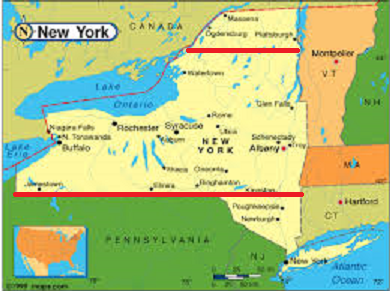
dispute between
Massachusetts and New York paralleled that between Connecticut and
Pennsylvania. Massachusetts
insisted on its sea-to-sea
charter, notwithstanding the later British recognition of and
acquisition of the
Dutch
colony of New York.
The
dispute between
Massachusetts and New York paralleled that between Connecticut and
Pennsylvania. Massachusetts
insisted on its sea-to-sea
charter, notwithstanding the later British recognition of and
acquisition of the
Dutch
colony of New York.
The
fact that
Connecticut lost such a claim might have given the Massachusetts
government
pause, but in fact it was Massachusetts that initiated the request for
a
hearing in June 1784. The
state was
nothing if not audacious in its suit, claiming a strip of land 150
miles from
north to south across the entire state of New York.
(Massachusetts
at the time included Maine, and extended farther north than it does
today.) If upheld in its entirety, the claim would
have reduced New York to the triangle between Pennsylvania and
Connecticut
running down to the city of New York, plus a detached strip along the
Canadian
border.
In
practice,
however, Massachusetts appears to have been interested primarily in the
western portion of the strip, still in the hands of the Iroquois nation (see From Conquest to Purchase) and ripe for coerced native sale and resale (at a large markup) to white settlers.
As the New York agents put it, “The Claim of
Massachusetts is
Vague and indefinite, comprehending ancient (white) Settlements (in eastern New York) for which
Massachusetts
confessedly (does) not mean to contend.”
New
York responded
in December, and agents for the two states conferred on judges. They agreed on nine judges
in June 1785. Delay
ensued when some of the judges proved
unable or unwilling to serve. The
delay
gave time for Massachusetts and New York to reconsider their positions. Their two groups of agents
began to talk to
each other.
Proceeding
to trial
was risky. The
losing party might come
away with nothing. The
state of
Massachusetts was in the grip of recession, the same recession that led
to Shays Rebellion when farmers resisted foreclosure for failure to pay
taxes. Massachusetts
needed money, not
sovereignty over a remote region in western New York.
Eventually
both
legislatures authorized their agents to settle the case among
themselves,
rather than waiting for Confederation judges.
Massachusetts conceded sovereignty to New York, but New
York authorized
Massachusetts to buy (via coerced purchase from the Iroquois) and sell
(to white settlers) six million acres surrounding what is now Buffalo. The two states entered
their agreement on the
journal of Congress in October 1787, and court never sat. Massachusetts sold its rights to a land company
for $200,000 in badly needed cash.
In
this controversy,
the mere existence of a federal resolution process provided the
impetus
toward settlement.
South Carolina
vs. Georgia
 Even
while the
previous dispute was gestating, South Carolina brought the next case
before
Congress. In this
case, the prolix
provisions for striking out judges would be tested for the first and
only time.
Even
while the
previous dispute was gestating, South Carolina brought the next case
before
Congress. In this
case, the prolix
provisions for striking out judges would be tested for the first and
only time.
The
boundary
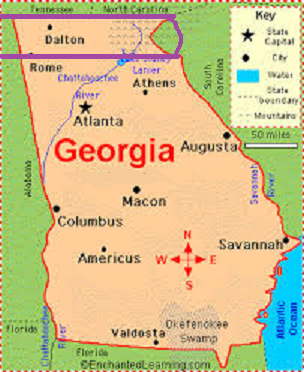
between Georgia and South Carolina, as charter boundaries go, was
fairly
straightforward. It ran from
the sea up the
Savannah River to its source, or to the 35th
parallel, whichever
came first. If the
source was south of
the parallel, the boundary ran west to the Mississippi, and South
Carolina had
a narrow strip of western land to call its own.
If the source was north of the parallel, then South
Carolina was
enclosed.
However,
like most
rivers, the Savannah forms from a confluence of tributaries. South Carolina stated the
point at issue
succinctly in its petition to Congress on July 1, 1785: “(South
Carolina) contends (that) the River Savannah loses that name at the
Confluence
of the Tugoloo and Keowee Rivers, consequently that spot is the head of
the
Savannah River; the State of Georgia, on the other hand, contends, that
the
source of the Keowee River is to be considered as the head of the
Savannah
River.”
Georgia was
notified, and agents for the two states appeared
before Congress on September 4, 1786.
The agents reported, one week later, that they could not
agree on
judges. Thus it was
that on September 13
Congress named 39 individuals, three from each of the states, to sit as
potential judges. The
journals do not
record how Congress came up with these names or what assurance they had
that
any of the judges would be willing to serve.
Then the two groups
of agents alternated in striking out
names; on what grounds we know not.
They
reduced the panel from 39 potential judges to 13, and finally the 13
names were
placed in a box and nine names were drawn out.
The nine judges selected included James Madison and John
Dickinson. Congress directed
the agents and judges to assemble in New
York, where Congress was then sitting, in May 1787.
Once again, court
never sat.
The agents hashed the matter out among themselves, and
compromised
(April 28, 1787). The
boundary was
indeed to run up the tributaries to the Savannah, per Georgia. But, to assuage South
Carolina, it was to run
up the western tributaries, the
Chattooga and Tugoloo, rather than the eastern
tributary, the Keowee. This
gave South
Carolina control over about 200 square miles between the rivers, in
which the
largest town today is Seneca.
Two of the bypassed
judges, who had travelled to New York,
filed a claim with Congress for compensation.
Congress, which had no money, told them to apply to South
Carolina and
Georgia.
The dispute
resolution clause, convoluted as it was, must be
accounted a success. It
ended one
long-festering controversy and led to out-of-court settlements in two
others. The
Constitution of the United States (COTUS)
retained the federal
role in resolving state boundary disputes; but with a standing federal
judiciary, special-purpose courts were no longer necessary. The COTUS gives original
jurisdiction over
all cases involving one or more states to the Supreme Court.
Sources: J.
C. Bancroft Davis, Federal
Courts Prior to the Adoption of the Constitution, appendix
to United States Reports Volume 131, 1888; Journals
of the Continental Congress, Volumes
21 through 32; Frederick W. Gnichtel, The Trenton
Decree of 1782 and the Pennamite
War,
1920
©
2016 Clionic Enterprises | Back
to Home Page | Back
to "Accomplishments" |